Showing posts with label Backcountry Skiing. Show all posts

Sunday, March 04, 2007

Sequoia National Park: Soccer Fields

Over the last few weeks, winter has finally arrived in Southern California. This Friday afternoon, I packed up my car, picked up my friend Brett, and headed north for my first trip of the year to Sequoia National Park. We arrived at our friends' Chris and John's house in Three Rivers 6.5 hours after leaving San Diego (gotta love LA traffic!). As always, they were great hosts and greeted us with great food and lots of wine. Over the course of the night, the rest of our friends (Carl, Dianna, and Tyler) arrived.

We set out the next morning at 6:30 to head up into the park. On our way up, we stopped to use the restrooms at the Wolverton recreation area. This was the site of the day's first major lesson. Carl, Tyler and I were all sitting on the toilet trying to do our business. The conversation goes something like this:
Tyler: Don't you hate it when you're trying really hard to go because you know you'll eventually have to and the last thing you want to do is to have take a pooh when you're out on the trail?
Carl: Dude......whatever you do, DON'T PUSH! This friend of mine who's training to be a nurse has been doing EMT ride a-longs. He told me that seemingly every night around 7:30, they get a call for some 50 year old guy who just had a heart attack. He gets home from a bad day at work, his wife gives him grief about something, so he heads up to the bathroom to take a pooh and escape from it all. Unfortunately, he pushes too hard and he ends up having a heart attack. So whatever you do, DON'T PUSH!
We all have a good laugh about it. I finish and head out to the cars. It seemed that both Tyler and Carl took Carl's pearls of wisdom to heart as they didn't come out of the bathroom for what seemed like a good 10 minutes.

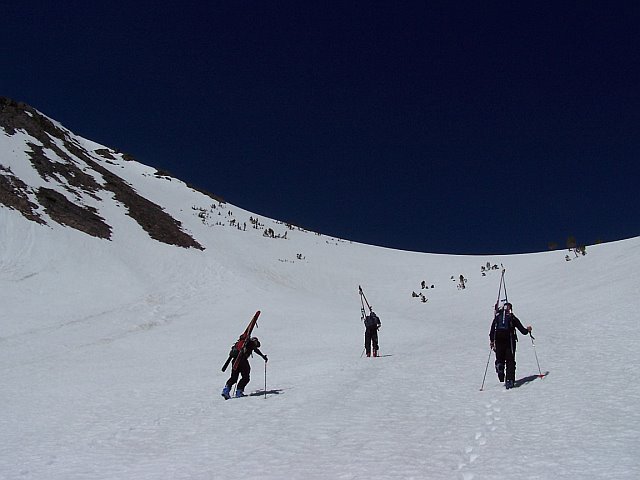
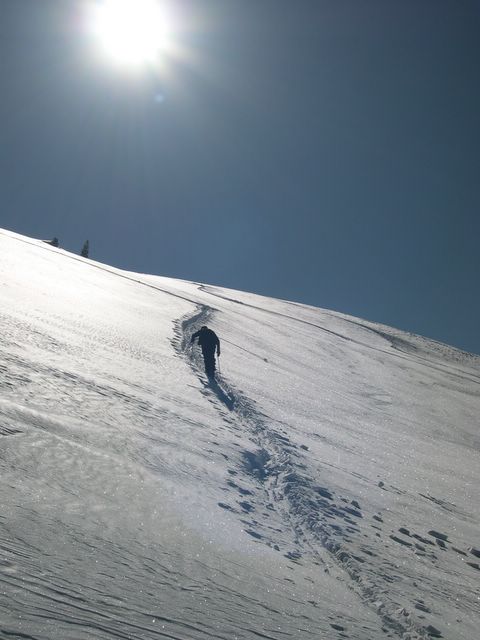
We set out from the Wolverton parking lot (7200') around 7:30. We initially started on the Panther Gap trail before taking a left and heading up the Pear Lake trail, which took us up to the "Hump". (9200') The trail is marked with Yellow Reflective Squares on the trees. However, they are spaced very far apart. If there isn't already a skin track in place, the best recommendation I can give is to aim to stay on top of the ridge as it climbs up. Unfortunately, Carl had to bail out before we got to the hump due to knee pain from a pre-existing injury.

From the hump, we left our skins on and descended a few hundred vertical feet to get to Heather Lake. After crossing Heather Lake (watch out later in the season...Carl broke through the ice 2 seasons ago), you climb a few hundred feet to the base of the ridge on the other side of the lake. This is the base of the run we call the Soccer Fields. They're called the soccer fields, because the top looks like 2 soccer fields that were placed end on end at a 20-25 degree pitch.
We broke trail and after another hour (4h20min after leaving the parking lot), we were up at the top (10,100').

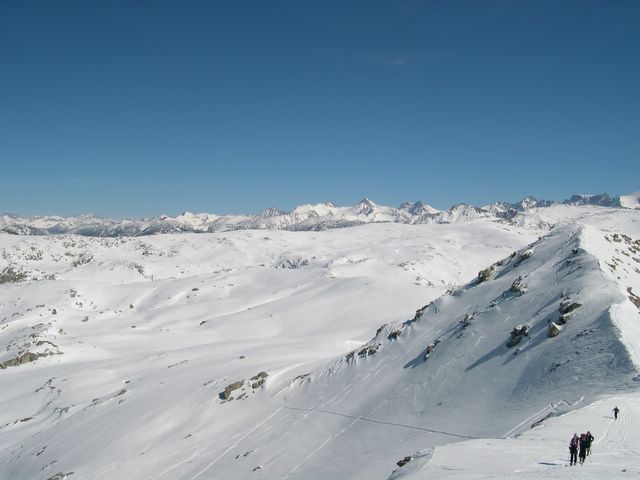
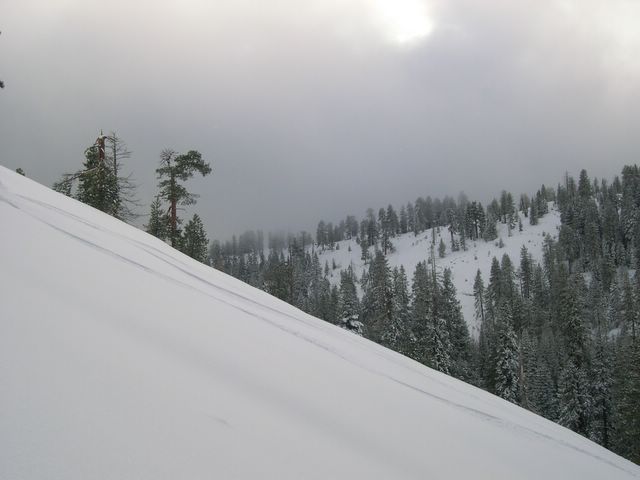
View From the Top of the Hump


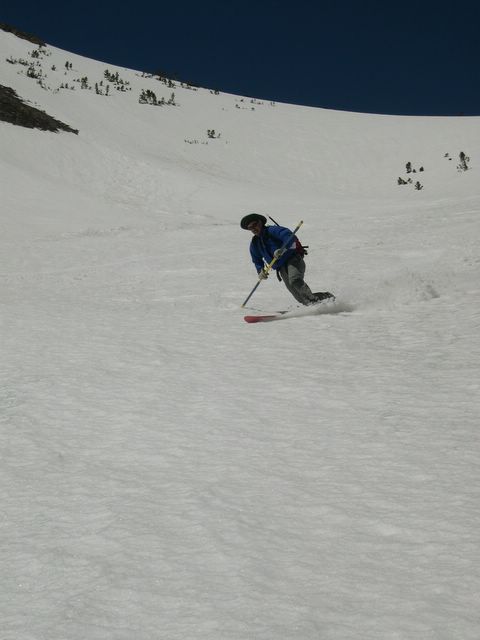
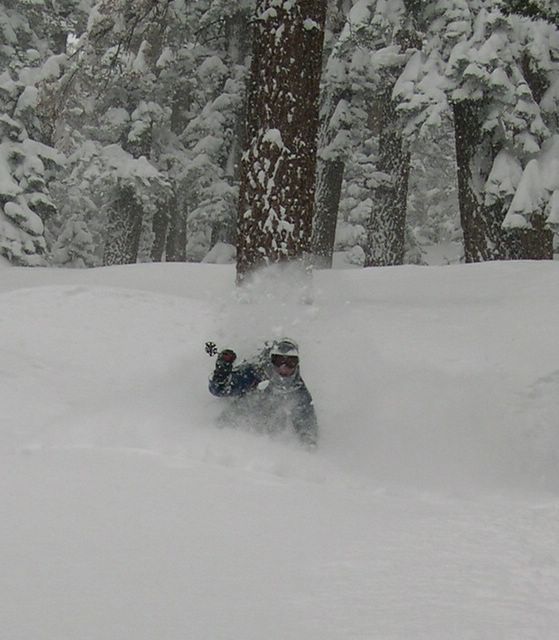
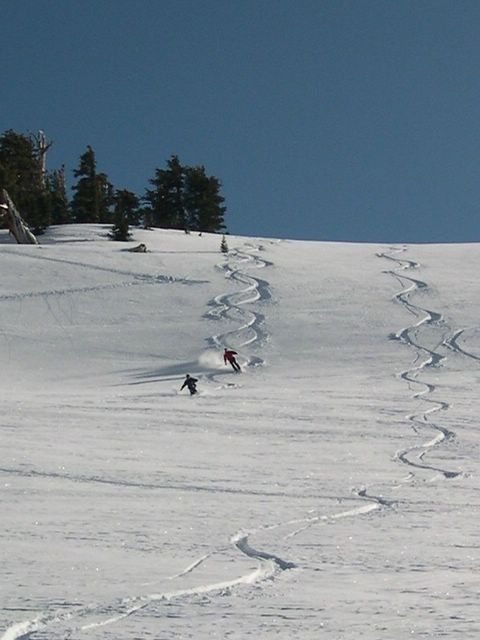
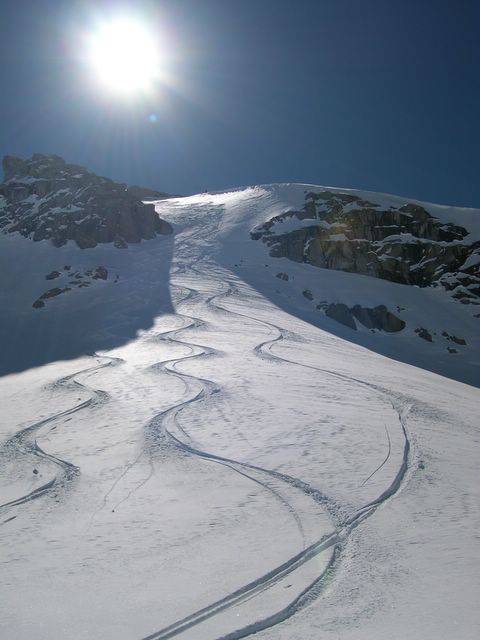
John, Steve, and I made it up to the top before all of the others. We were surprised when we saw how far back Brett had fallen. When he got a little closer, we saw him clutching a single pole with both hands to help him on the skin up. It turned out that one of his 10 year old Life Link carbon fiber poles had snapped when he used it knock snow off his boot. Since backcountry skiers have to adapt and overcome, that's what we did. Using duct tape and a piece of a tree branch, we built a splint to hold the two pieces of his pole together. The pole was a few inches shorter, but it held up for two laps and the skin out.The top of the soccer fields is a wide open 20-25 degree slope. Because of its northern exposure, the snow had stayed dry despite the warm temperatures and we got in some fabulous turns. After about 550 vertical feet, the wide open slope gives way to a fun 350 vertical ft mix of rocks and trees. Overall, we were skiing on 8-12" of soft, relatively dry fluff.
When we got ready to skin up for the second run, we ran into our second equipment issue. Both of my Life Link poles mysteriously would not let me change their length. When I loosened the lower half of the pole (which after a few turns is supposed to let the pole extend or contract), it wouldn't move. It felt like the piece in the upper half of the pole that the lower half screws into was jammed. After 10 minutes of fighting with the pole, I gave up on it. (WD-40 later that evening seemed to do the trick)

On the second skin up, I started cursing myself for the steep skin track I had laid. Apparently, my thin straight skins had better traction in the fresh snow when I was breaking trail than in the slicked beaten-down skin track when we were heading up the second time. Once again, I seemed to be moving back 1 ft for ever 2 ft I went forwards, was cursing Jim (from Norpine) and was thoroughly frustrated.

The second run was also great. This time we went a bit further to skier's right when going through the rocky section. Towards the bottom, John skied past us over what he thought was a rollover. It ended up being a 20 ft cliff. John, being the great skier that he is, took the surprise with ease and landed it beautifully. So then, after a bit of goading, I decided to huck myself off of it too. John said the landing was super soft and that the conditions were ideal. Still I had never really jumped anything bigger than 10' before. So I was very nervous and I thought about it a little too much. I didn't chicken out. However, I also didn't approach it with the right attitude. Even though I decided to jump, I was hesitant about it. I took one turn too many, killed too much speed, had to really push off to clear the rock, got leaning back too far and the result was a complete yard sale. I ended up being fine and I'm glad I did it. But in the future I really need to approach it with an attitude of success. Attitude really is everything!At this point we decided to head home for the day. Once we got to the hump, instead of following the skin track back, we went to skier's right along the ridge and skied down a beautiful, north facing, 25-30 degree meadow with a sprinkling of sequoias. Due to the lower elevation, the snow much heavier than the Soccer Fields. But with a little speed it was very skiable and a lot of fun. It would definitely be a great place to come back to after a fresh snowfall. Once we made it to the end of the meadow, we traversed to skier's left until we made our way back around the ridge to the Pear Lake Trail. After a fun luge run, we found ourselves back at the parking with a cold 12 pack of beer waiting for us. All in all, it was another great day in the backcountry.

Friday, February 23, 2007

Grand Teton President's Day Weekend Trip

After getting back from my early January trip to Alta with my dad, I kept waiting for it to start snowing in California. When the snow never came, I kept canceling ski trips and had almost given up on their being a California ski season this year. I signed up for my first triathlon of the season (Wildflower Olympic) a few weeks ago and had almost shifted priorities to training for that. Luckily my buddy John asked me to join him on a president's day weekend backcountry trip in Grand Teton National Park and my priorities are back where they should be.

I flew into Salt Lake last Friday afternoon. After spending the day skiing at Alta, John picked me up and we started the drive up to Jackson. I was expecting that arriving without reservations on President's Day weekend, we'd have problems finding a room. I was wrong. The town was deserted. After staying in Hoback Junction the first night, we split our time in Jackson between the Motel Six (an unbeatable deal at $40 a night) and a friend's condo. The only downside to the Motel Six is that it doesn't have a hot tub.

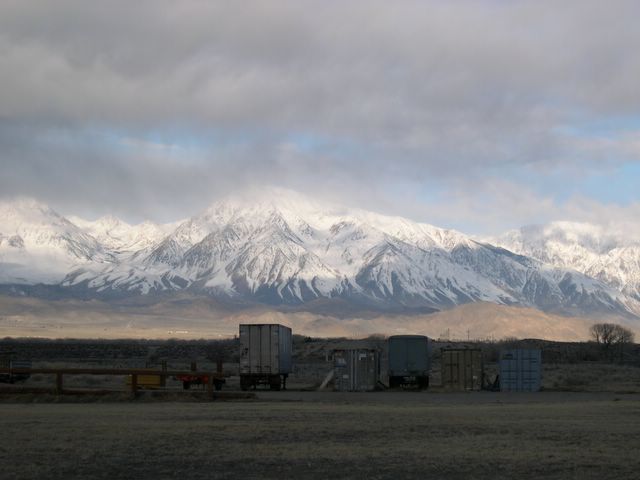
We met up with the rest of the group at 7 AM by a trail head near Taggert Lake on Saturday. We started off by climbing up "25 Short" and then skinning over to 10696. Due to high winds and wind-packed snow, we didn't go any higher than ~10,300'. From there, we skied down the ridge to the top of Maverick's. Just as last year, the first turns of the year in my AT boots had me wondering how I could ever ski in something so soft. But the wind-packed snow of 10696 eventually turned to soft powder when we got over to the tree protected east/northeast face of Maverick's. We had a beautiful run (2500' vertical) with 6-8" of powder on moderately pitched terrain through a mixture of trees and open fields. By the time I was a quarter of the way down, I once again had gotten used to my AT boots (Garmont G-Rides) and enjoyed every turn . The downside to skiing Maverick's from "25 Short" is that it requires an hour long skin out. We finished the day by enjoying a few pitchers of beer at Dornan's. If you're ever up that way, I highly recommend stopping there. The view of the Tetons (basically the same as the pic below) from the bar is absolutely stunning.
On Sunday, we decided to ski "Wimpy's", the next peak to the south of Maverick's. Initially, I was relieved to see that there was a skin track already put in. However, I was soon cursing Jim, the very old school owner of Norpine in San Diego, who insisted (when I bought my equipment last year) that I should just get straight skins. The skin track was obviously put in by people with fat skis and wall to wall carpet underneath. For every 2 feet that I went forward, it seemed like I'd slide back 1. (And that was after pushing as hard as I could with my arms to help keep from sliding back.) On the whole, the run down is a 2300' vertical mix of moderately pitched (25-35 degrees) trees and wide open meadows. For the first run, we skied down along the ridge to skier's left. If you go too far over, it gets pretty cliffy. The snow (6" mix of fluff and sunbaked slab on top of fluff) was decent on the first run. Right about the time we started skinning back up, it started snowing. By the time we started skiing down, there was a nice 3" of fresh snow. We skied more down the middle (to skier's right) this time and had a fantastic run. It seemed like every time we'd head into the trees it would open up to a sweet powder shot. The second run earned Wimpy's a big thumbs up. Another positive for Wimpy's is that you don't need skins for the ski out.
On Monday morning, we awoke to 5" of new snow (in the mountains..not in town) and set out to ski Albright...the next mountain south of Wimpy's. The access to Albright is the same (Death Canyon trailhead). When you hit the Valley trail, you stay on it past the turn off to the bottom of Wimpy's. We stayed on the trail until just before Phelps Lake when we started on our way up the south side of the ridge (still on the east facing part...just on the southernmost part of it) of Albright. It was a gorgeous day...sunny, low 30's, and 8-10" of soft snow. We topped out about 150' below the summit (~10,900')and ate a nice lunch while contemplating the untouched powder field awaiting us. I've said it before. But I'll say it again. One of the beauties of backcountry skiing vs. lift-serviced is that you can actually take the time to relax and enjoy the whole powder experience. For our first run, we had a beautiful 3300' vertical run sticking to the south side of the ridge (between our skin track and the main gully) through a mix of open meadows and thin glades. The snow was phenomenal. For our second run, we only went up about 2500' and then skied the same trees before finishing heading into the heart of the gulley about halfway down. The only trick to the gulley was to stick to the right side as the left (southeast facing) side was pretty baked. Towards the bottom, you need to head right to avoid a sizable (~20-30') cliff band.On Tuesday, it was just John and I. We headed back to ski Maverick's again. This time we approached it from the south using the same trailhead we used for Wimpy's and Albright. The only challenge was that the entire mountain was covered with dense clouds. So it made the whole process of actually finding the base of Maverick's from the Valley Trail a bit tricky. In the end we got lucky and guessed right. Besides lucking out in actually finding our way to the base of Maverick's, John and I also lucked out with the best skiing (by far) of the entire 4 days. Most of Maverick's was east/northeast facing (which meant it wasn't baked at all) and it didn't look like anyone had been there since it snowed on Sunday night. Due to the high winds, we only hiked up 1600'. But we did 3 full laps and got in my 3 best runs of the year. It was fairly steep (30-40 degrees) and full of surprises. You'd duck through a set of trees, catch air off of a lip and find yourself in a wide open meadow that was all yours to carve up.
Like all good things, our stay in Jackson had to come to an end. John and I drove back to Salt Lake on Tuesday night. But we got in a half day at Alta on Wednesday before John dropped me off at the airport. From the remnants of fluff we found at Alta, I can only imagine how great Monday must have been there.

Sunday, August 06, 2006

More Thoughts on Why We Love Gear

As I was on a bike ride yesterday trying to rationalize why it was absolutely necessary for me to shell out $120 for a heart rate monitor, I inevitably came back to pondering my last entry when I put it out there that men love shopping just as much as women do. The more I thought about it, the more I realized that I needed to clarify my thoughts a little more.

First, why is it that it's so much fun to buy gear? The way I see it, gear is the adult version of toys. While it may help professional athletes perform better and earn more money, for the rest of us, it just helps us to play our games better and to one up our friends. Just as getting a supersoaker squirt gun instantly made you a force to be reckoned with in the neighborhood squirt gun battles when you were 9 years old, the $5000 carbon fiber road bike gives you that much more of an edge over the other guys you ride with.

Second, I think the reason that the belief persists that men don't like shopping is that we really don't like the act of shopping. We like spending the money for the new gear. But whereas women will spend an entire day shopping for one shirt, we like to make each shopping trip a quick in and out mission. We research what we want to get, find it, and buy it. We don't try on 30 other jackets or go to 10 other stores to see if we can save $5. Generally, we don't just go to REI just for the sake of seeing if there's anything we're interested in. If we're going to go, its for the purpose of buying one specific thing that we've decided on before we get there.

Wednesday, August 02, 2006

Women Love Gucci, Men Love Gear

We men are always bitching about women and their shopping. We are flabergasted at how they could spend so much money on shoes and handbags. But I have to admit that the truth is, we men are just as bad. Women's weakness is clothes where as ours is gear. I have to admit that I am very fond of it. I'm in to my hobbies (skiing, bicycling, travelling, etc) and I love buying all the gadgets that go along with it. I often tell my friends that the quality of your bike or your skis only makes a small difference as to how good you actually are. I firmly believe that. However, I still enjoy splurging and treating myself to a new sleeping bag or pair of gloves. Last year was a particular good year as I was updating my alpine ski gear for the first time in 7 years and just buying all of my backcountry gear for the first time. November's credit card bill was absolutely horrific. It's looking like this year is going to be a little easier on my mastercard. The past few weeks have been especially fun as I took advantage of the Sierra Trading Posts' 20th anniversary sale and got some black diamond gloves for $19 and a Sierra Designs Down Jacket for $55. The biggest items I plan on buying this season include a new fleece jacket, GPS device, and altimeter.

Tuesday, May 23, 2006

Backcountry Ski Trip Report: TTips weekend at Tobacco Flats

After making skiing my number one priority this winter, my other committments (school, work, family, etc) finally won out and kept me from doing any skiing during the last 5 weeks. So when I found out about the Telemark Tips gathering taking place this past weekend at Tobacco Flats on the East Side of the Sierras, I was all ready to load up my car and make the journey from San Diego.

Truth be told, I was a bit concerned with the weather. As of Thursday, it looked like we were going to be getting some rain on Sunday. The only question was when. But Friday morning, the latest weather report from Howard Scheckter, Mammoth's Local forecaster, said we weren't going to get anything until Sunday afternoon. That gave us the green light.

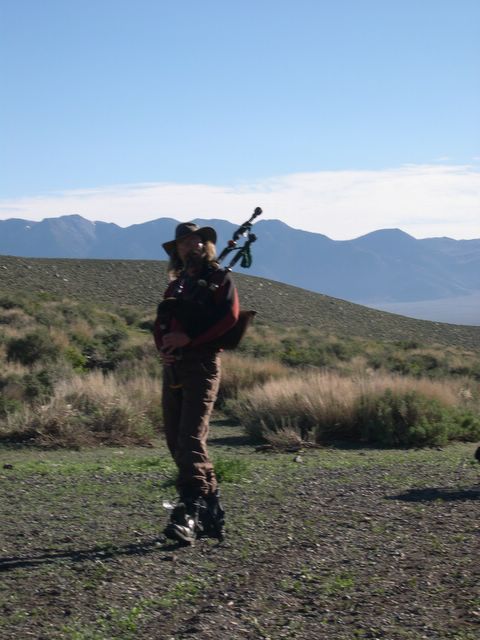
After 6.5 hours in the car, we made it to the Tobacco Flats camp site at 1:30 AM. The directions were spot on. I woke up at 6, half surprised that I was the 4th person up. I guess everyone wasn't as hardcore as I thought. Eventually the rest of the crew up. After a nice leisurely breakfast, a cup of French Roast (thanks Jim), and a motivating bag pipe performance (you the man Charlie), a group of about 15 of us set out around 7:30. Being my first time there, I was content to follow the rest of the gang. About halfway up, we split into two groups. The Socal group (myself included) went up Old Man Bowl on Little Morrison. The rest of the group headed for the Hippie Chutes (also called Finger Chutes) and Mt Aggie.
During climb up, I was surprised by how much the 5 weeks off had affected my stamina. After only 4 hours, my legs were exhausted and my lungs were gasping for air. By the time we made it to the top of the Old Man Bowl at 11:30, it had already softened up quite a bit. We stopped when I started sinking in up to my knees with every step. The run down was awesome though. This was my first time skiing corn and it was wonderful. The base was hard with a nice soft top layer. I cranked big GS turns all the way down. As much as I wanted to stop and savour the run, I was having too much fun to stop.
Once we made it to the base of the bowl (~1130), we had a decision to make. We could either keep skiing or head back to the campsite and start drinking. I'm embarassed to say that we were all dead tired and chose option B. We were back at Tobacco Flats drinking cans of PBR by noon. The other group didn't arrive back at the site until 4 pm. They ended up making it up to the top of Aggie and doing several laps on the Hippie Chutes. They reported that the snow on the Hippie Chutes was still excellent as late as 3:45. After hearing how great their day was, we were looking forward to rallying and skiing the Hippie Chutes on Sunday.
As the afternoon went on, more and more people started showing up. By the end, we probably had about 25-30 people there. It was great to get to know all of these other people who share a passion for backcountry skiing. As a couple of us remarked, the gathering was really a testament the power of the internet. Five years ago this gathering would not have been possible. But thanks to the Teletalk forum on Telemark Tips, a group of strangers coming from everywhere from Seattle to San Diego was able to get together for a weekend of skiing. Most of my friends think it's a bit weird to be driving 7 hours to meet a group of strangers I met over the internet. If I were them, I'd think so too. But let's face it, there aren't that many backcountry skiers in Southern California and the internet allows us to all come together. More importantly, if a person is into backcountry skiing, they might be a bit crazy (aren’t we all?). But deep down, they’re probably a pretty good person.

The last weather forecast we saw before driving up said that it wasn’t supposed to start raining until Sunday afternoon. Unfortunately, I started hearing drops hit my tent around 1:30 AM. By 3:00 AM, those drops had turned into a downpour and heavy winds. Worse for me, I was too lazy when we set up camp Friday night and too drunk on Saturday to put on the rain fly. So I bailed from the tent around 3 when the tent started leaking like a sieve and finished the night in the front seat of Tyler’s car. Needless to say, we didn’t go out skiing on Sunday. So the Hippie Chutes will have to wait until next year.

Monday, March 27, 2006

Backcountry Ski Trip Report: Baden-Powell/9088 Trip Report

I joined up with Dave Puzo (Carlsbad) and Scott Siegrest(Hermosa Beach), whom I met on Telemark Tips, to ski Mt. Baden-Powell this past Sunday. We met up at the Vincent Gulch parking lot parking lot at 7:45. From there we hiked about 1/3 mile along the Angeles Crest highway to the North Gulley(shown by where creek runs down on topo map). The highway is normally just closed in the winter. However, I doubt it will be open at all this summer. At one point, half a lane's worth of the highway (and the supporting ground underneath) has given way and slid down the mountain.


Due to the steep pitch in the gulley and the main bowl, we decided to leave the skins in the car and boot-pack up. However, the snow level in the gulley was far below normal. (We could see the creek running. From what I hear, there is normally 10-15 feet of snow in the creekbed from accumulated snowfall and avalanche runoff.) Since we also decided to leave the rope in the car, we were forced to abondon our plan to hike up the gulley when we got to a sketchy section about 20 minutes in. At that point, we were considering turning back and skinning up the main trail that starts at the parking lot. But as always, once you commit to one course of action, it is difficult to admit defeat and turn back. So we decided to climb the west side of the gulley until we made the ridge and then followed the west ridge up. The climb up the ridge was a bit sketchy. The rock was very crumbly and the mud was fairly loose. Once we started hiking up along the ridge, we wished that we would have brought our skins along. The pitch was low and the snow was deep. The extra 1 lb that the skins weigh seemed like a small price to pay considering we were sinking 1-2 feet into the snow with every step.

Once at the top, we found that the west ridge actually had lead us to the unnamed peak 9088 vice Mt Baden-Powell. We momentarily considered continuing on to Baden-Powell. But after 5 hours of hiking up, we were just too tired. Considering how tough the hike was, the ski down was surprisingly good. We skied the gulley just to the west of the ridge we followed to the top. The top layer (1-2 inches) that wouldn't support us in our ski boots, was more than enough to support us on our skis going down. For the first half, it was almost as if we were skiing a groomer with 2 inches of loose/wet snow on top. About 2/3 of the way down, avalanche debris in the gulley forced us into survival skiing mode. Once past the avalanche debris however, the snow on the last section, although thin and wet, was surprisingly good. We were able to ski all the way to the road.

Recommendations: If you do plan on going up the main north gulley, I recommend that you bring a rope. We wish we would have brought it so we could have proceeded with our orginal plan. In the gulley that we skied, the cover was thin for the bottom third. So this storm coming in Tuesday/Wednesday should help to fill it in. Due to the steep canyon walls and it being an obvious slide path, I would wait a while to ski any of the gulleys. While we were sitting on the top of Burnham eating lunch, Mt Throop caught my eye. It looks to have some nice steep north/northeast facing slopes. They might be worth checking out.

Avalanche Activity: Most of the avalanches we saw were wet slides on west facing slopes. They looked to be several days old and a number had slid all the way to the ground. We experienced some sluffing of the top layer (~2 inches) at a few places. But there was nothing signficant while we were there.

Tuesday, March 21, 2006

Avalanche Safety Course

At the very beginning of this ski season, one of the promises I made to myself was to take an avalanche safety course. Previously, I had done a little backcountry skiing (twice in high school) and had skied quite a bit of powder, but I didn’t have a clue when it came to whether the slope I was on would actually slide. Looking back at some of the things I had done in the past, I knew that I was lucky not to have gotten hurt before.

Back in college, I did the standard semester abroad my junior year. I lucked out and ended up studying in Grenoble, France during the winter of 1999. That turned out to be one of the biggest snow years Europe had in recent years. Consequently, every weekend turned out to be a powder weekend. If you don’t know, there is no such thing as avalanche control in Europe. You go off-piste at your own risk. That winter, we used what we called the “Three-Track” Rule. It stated that if there were three or more tracks going off piste, it could be assumed that any avalanche that could take place, would have already taken place and it must therefore be safe. Not very smart, I know. But we were just reckless college students then.

Even though taking the avalanche safety course was one of my top priorities at the beginning of the season, I kept on putting off taking the course. I never had a sense of urgency. After all, one of the people who I normally skied with was very experienced in the backcountry. I trusted that he knew when it was safe to be out and when it wasn’t. I conveniently ignored the fact that no one else in our group had any significant experience. Furthermore, I bought into the argument that the western Sierra snow pack was more stable and not as prone to avalanches.

Eventually, I decided that these excuses just didn’t hold up to closer scrutiny and demanded that I learn more about avalanche safety. No group should rely solely on one person’s judgment. Each member should have sufficient knowledge to form their own opinions and to contribute to group decisions. If you’re just depending on one person, who is going to back them up when they make a mistake? What would happen if they got hurt? Besides the group responsibility issues, the western Sierra snow pack argument didn’t really hold up either. Two weekends ago we were skiing on 2.5 feet of super dry snow that was more like what you’d find in Utah than the Western Sierras. Despite the fact that we didn’t set off any avalanches, the snow that weekend was definitely susceptible to sliding. Again, nothing happened to us. But sooner or later everyone’s luck runs out. So I finally decided that it was time to give up a weekend of skiing, take an avalanche safety course, and take personal responsibility for my own safety while out in the backcountry. I no longer wanted to rely solely on luck and my friend’s judgment.

So I spent last weekend (Saturday through Monday) taking the Sierra Mountain Center Avalanche Level One course that was being given in Bishop, CA. The course was taught by S.P. Parker. He opened the course off by telling us that the course was not going to give us the one answer. In other words, nothing we were going to learn was going to tell us that a slope was 100% safe. There are simply too many factors that influence whether or not a slope will slide. Instead, the course was designed to teach you the right questions to ask yourself so that you could make an informed decision and minimize the risk of your or your party getting caught in an avalanche.

On the first day, we spent the morning in the classroom discussing case studies, types of avalanches, rescue procedures, how terrain influences the potential for avalanches, and routefinding. The afternoon was spent in the field looking at the actual terrain for signs of avalanche danger and practicing using our beacons. I found this really useful since I had never had much success practicing with my beacon before. (I’ve got an Ortovox M2. While its range is better than the digital beacons, it definitely takes more practice to use it effectively.)

On day two, we again spent the morning in the classroom covering additional case studies, group dynamics (what leads groups to make poor decisions), influence of weather, and snow pack theory. In the afternoon, we drove to Table Mountain and dug snow pits. S.P. showed us how to identify the different layers and to perform tests to determine how well the different layers had bonded to each other. I was surprised when S.P. said that he didn’t dig snow pits very often. He only considers them to be one of many factors that help you to determine what level of avalanche danger exists. He emphasized that other factors such as slope angle, wind loading, weather, sun exposure, terrain triggers, how the snow feels (slabby, soft, crusty, etc) and signs of recent avalanche activity should all help you to form a good picture of the degree of avalanche danger present. You only need to dig a pit when you are still unsure after looking at all these other factors.

Day three was spent in the field near Mammoth Rock. We spent the morning examining the terrain for signs of avalanche danger (recent slide activity, wind loading, slope angle, etc), discussing safe routes, and digging another snow pit. In the afternoon, we got in a short run (8” of excellent fluff with wind-pack in places) before practicing multiple burial (2 –3 people) searches. I found the multiple burial scenario much more challenging. Personally, I had a difficult time with my analog beacon (M-2) picking out where each victim was. I realize that I still need to a lot more practice with this scenario. We also learned that team organization plays a big role in coordinating search efforts to make sure that everyone isn’t converging on the same victim.

So was the course worth the $350? Definitely! You can’t put a price on your life. But like S.P. said in the beginning, it’s not the answer. If you are looking for the definitive safety guarantee, you are better off giving up backcountry skiing and staying at a resort. As an avalanche safety instructor should, S.P. comes off as being very risk averse and prudent. In the course, he would never say that a pitch is completely safe to ski down or skin up. It always felt like the textbook answer was to either go up or down the windblown section with no snow on it. But that is precisely because avalanche safety is not an exact science. It's about minimizing risk intead of eliminating it as well as knowing how much risk you are incuring and being comfortable with that. I do feel that the course gave me the tools to better judge how much risk I am taking on each run. Right now, I know the questions to ask and which factors are most important. The next step is to gain more experience so that I can better weight all of these factors to form a more accurate picture.

Wednesday, March 15, 2006

Lessons Learned from Last Weekend

1. Bring a Repair Kit: A number of articles I've read have said to always bring a repair kit with you when going into the backcountry. I have yet to bring one. But this weekend, my buddy Carl was evidence of wisdom of those articles. On the first day out, the loop at the front and the tail clip of the same skin broke. Luckily, we had some duct tape. But Carl was reduced to attaching his skins to his skis by wrapping the front and back with duct tape. So if I don't want Murphy to strike me, I guess I'll have to be responsible and put together a real repair kit before I go out for another tour.

2. Never Feed Carl Whole Heads of Garlic:
One of the side dishes at dinner Friday night was whole heads of roasted Garlic. Apparently, one of garlic's side effects is bad gas. Carl was farting at a rate of once every 10-15 minutes throughout the entire day Friday. Because Carl was graciously letting Nellie and I break trail, it didn't affect us too much. But at one point Carl told us that he really wished he was in better shape because when he'd fart, he didn't have the energy to speed up and escape the smell. As we were heading back to the car at the end of the day, I let Carl go ahead of me at one point. Sure enough he let one out and I realized what he meant. It smelled like I had just been doused with some sort of garlic mist. I was in awe...not sure whether to be disgusted or to admire Carl for his amazing powers.

Monday, March 13, 2006

Backcountry Ski Trip Report: The Good Snow Karma Continues

They say that good things come to good people. I guess that Carl, Nellie, and I have been doing something right since our good snow karma continued this past weekend. This weekend was perhaps the best skiing I’ve ever had and everything just seemed to work out right.

Our original plans were to head out Friday morning and spend Friday and Saturday night at the Pear Lake Hut in Sequoia National Park. As luck would have it, the Sierras were hit by unusually cold temperatures and heavy snows from last Monday until Sunday. As a measure of just how cold it was, the snow line reached to just inside of the park entrance, or 7,000 ft below the elevation we'd be skiing at. Due to avalanche conditions and a potential lack of visibility, we had already decided to spend the weekend doing day trips instead of heading out to the hut. When we got to the Wolverton parking lot, a ranger told us that Evan, the hut caretaker, had radioed in reporting 3 ft of new snow at the hut. There was no way any of us were up for breaking trail through that much snow. So we were happy with our decision. Plus, with this much good snow, there was no need to go all the way to the hut to get good turns.
So we set off down the trail from Wolverton. The 10" of light fluff covering the skin track told us the day was going to be great. We ended up going to "Alf's", a new area that Nellie had found earlier in the week. Just before we reached the intersection of the Pear Lake and Panther Gap Trails (bottom of the Hump), we broke off to the right heading for the ridge you would see if you were looking back as you were going up the Hump. Within 2 hours of leaving the parking lot, we had reached the top of Alf’s(8600'). Apart from a meadow on the far right portion of the ridge, all of the runs are in the trees. Moving from right to left, the runs get steeper and longer, increasing from 700' to 850' of vertical. As soon as I pointed my skis downhill, I knew that we were in for something special. The snow was thigh deep and super dry...dryer than anything I've every experienced in Utah. We were getting face shots with every turn. I had never experienced anything like this. I've skied lots of powder in my life. But this took the whole floating sensation to another level. It was so light that skiing in it was effortless.
On Saturday, we decided to ski 9975. Overnight, we had gotten another 8" of new snow. To minimize trail breaking, we followed the Pear Lake trail for as long as we could. Eventually, we had to break off. Breaking trail through 2.5' of snow, no matter how light it is, really sucks. But 4 hours after leaving the car, we finally made it to the top. We skied the north facing trees rather than the main bowl. The skiing there was even better than Alf’s. The snow was deeper and the runs were longer (900' vertical). In this case, the face shots were big enough to blind you momentarily. Luckily, the Sequoias are widely spaced and the woods are fairly clean. For Nellie and Carl (both telemarkers), the biggest surprise was that they now had to focus on when to breathe. They were getting so low in their turns that the snow would choke them if they breathed at the wrong time. We got in 3 runs on 9975 before darkness and aching thighs forced us to head out. I’d like to give a big thanks to the snowshoers who broke trail heading towards Panther Gap earlier that day. They saved us a good half hour on our trip back to the car.
On Sunday, we again skied Alf's. There was only 3" of new snow overnight. But the snow we got Friday night and Saturday had pretty much filled in our old tracks. The snow was still very good, but it had settled a bit since Friday and didn't seem quite as deep. It very well could have been just as good as Friday. But the previous 2 days, especially Saturday, had completely altered my inner sense of what constituted great powder. Runs we skied included Huck Me, Humpy’s, Tweaker, and The Bean. We got 4 runs in on Alf’s before we decided to head out.
As luck would have it, we ran into Chris (Nellie’s girlfriend) on the trail on our way out. She was coming back from some cross country skiing with a friend. Being the saint she is, Chris volunteered to run shuttle for us to allow us take a run down to Lodgepole. The run to Lodgepole is about 850’ of vertical. The first pitch was short and the trees were tight. I didn’t really get into a good rhythm. The entrance to the second pitch was a bit sketchy. There was still quite a bit of scrub brush to ski around. But after the first 15 yards, it was wonderful. There was enough snow to cover up all of the fallen trees and rocks that normally cover the pitch. Now you could just ski over them without having to worry about breaking you leg. The trees were a little bigger than at 9975 or Alf’s. Consequently it seemed that it was wider open under the canopy. I took advantage of that and just made big powder turns all the way down, enjoying my last face shots of the weekend.

All in all, it was perhaps the best weekend of skiing I’ve ever had. From the first face shot on Friday to our sweet Lodgepole run at the end of the day on Sunday, everything just seemed to go right.

Wednesday, March 08, 2006

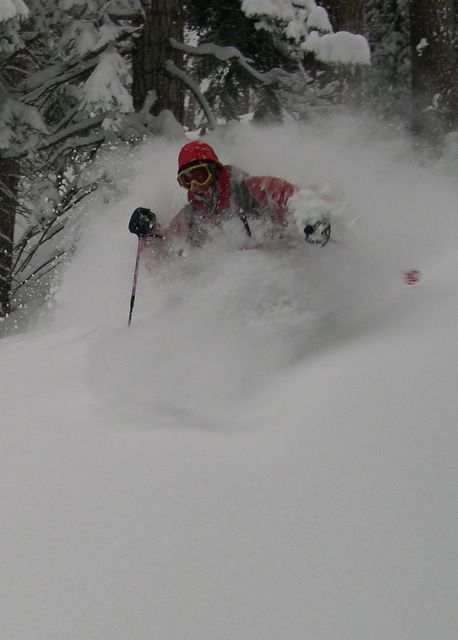
What Boots to Use: Alpine vs. AT

I just took up backcountry skiing this season. When I was buying my equipment, I really didn't ponder the question of whether to use my alpine boots (Solomon X-Screams) or to buy a pair of AT specific boots. With all the climbing involved, I knew that I wanted boots that were much lighter than my alpine boots.

I've realized that for most people, the question of what type of boot to use is not so clear. A number friends who have been talking about taking up AT have said they want to use their downhill boots. They figure that if they are going to expend so much energy going up a mountain, they don't want to be limited by their boots while going down.

I can understand where they're coming from. If I had asked that question in January (after my first time out with my new Garmont G-Rides), I probably would have said that alpine boots were the way to go. My trip to Sequoia over MLK weekend was my first time out in those boots. Going up hill in them great. They were warm, fit well, and I really liked how much the boot flexed in the walk mode. However, going downhill those first few times was a completely different story. I was used to big, stiff boots. So after I pointed my skis downhill and my AT boots started flexing like crazy, I didn't know what to do. I was either too far forward or too far back on my skis and the skis just didn't want to turn (or at least not when I wanted them to). I fell as many times that first day as I normally do in a year. So at the end of that first day, I was asking myself if I made a mistake buying AT boots.

But since that first day, the boots have really grown on me. Just because the boots are softer does not mean that you can't ski aggressive terrain with them. It just requires you to be softer and subtler in initiating your turns. You have to pay more attention to staying centered on your skis rather than leaning forward. When I used to hear people say that you don’t need stiff boots to ski powder, I never really believed them. After all, I had stiff boots and they were great in powder. But I understand what they mean now.

Getting back to the original question about whether to even buy AT boots, I see a couple of big questions that need to go into the decision. First, how far do you have to skin before you can ski downhill? If you have to skin for 2 hours before you even begin going uphill, the lighter AT boots are hands-down better. On the other hand, if the parking lot is at the base of the mountain, then the added comfort of AT boots going uphill wouldn't be so important. Secondly, how steep of terrain are you talking about skiing? The way I see it, unless you're going to be hucking big 30 footers, a good pair of high performance AT boots (like the G-Rides) should be able to handle anything. I've skied a couple of 35-degree chutes with them and they were great. So like all complicated questions, I guess it depends. But I'm plenty happy with my G-Rides.

If you have an opinion on this subject, I’d love to hear what you have to say.

Note: If you do end up buying AT boots, contrary to what I did, I'd recommend taking them out for a few days of lift serviced skiing before heading out into the backcountry. There will be an adjustment period. The last place you want to go through that painful adjustment is on a beautiful powder filled bowl that you just spent 2 hours climbing up.
Wednesday, March 01, 2006

Backcountry Ski Trip Report: Pear Lake Hut

I had my first Pear Lake Hut experience this past weekend. As I promised everyone who I went there with, I'm going to start off by saying that it was a terrible place, with terrible snow, and 2 terrible caretakers who will stop at nothing to make your stay there miserable. So if you don't get the point, DON'T GO TO THE PEAR LAKE HUT! Its not worth the 5 hour slog it takes to get there. Now if you've already decided not go there, please stop reading this article and never again come back to my blog. For those of you who want to hear all the details of my terrible Pear Lake Hut experience, keep reading.


This was my first time out on a backcountry trip that was longer than a day. To be honest, even though it was only a hut trip, I did have some anxiety about it throughout the week. Despite Nellie (see Wolverine man article) having sent out a good packing list, I still really didn't know what I would need. How much food was I going to go through each day? How many changes of clothing would I need? I didn't know. I wasn't sure whether to bring a full-sized backpack or to go with a daypack and attach stuff sacks to it. I decided to go with stuff sack option and packed a ton of food and twice as much clothing as I needed.

We set off from the Wolverton parking lot (at Sequoia National Park) on Friday morning. The weather was great. It was sunny and mid 40's. We followed the Pear Lake Trail up to the top of the hump. I had taken a portion of this trail before to go up to ski 9975. But the trail is much more challenging with a 40 lb pack on your back. From the hump you follow the trail down to Heather Lake and then follow the yellow triangles to the hut.

As much as I love skinning and the whole being out in nature thing, I go backcountry skiing so I can get good turns in. So while most of the party kept moving towards the hut, John, Tyler, and I made a short excursion up to the Soccer Fields (Just past Heather Lake and above the trail to the right). It was heavenly. The skin track was already in place. Apart from 2 sets of tracks from the previous group at the hut, we were making fresh tracks all the way down. We had about 8" of nice creamy powder. The runs started out as a wide open low grade bowl (~500' vert) and finished up with about 300' vertical through steeper terrain with some trees and rocks. It wasn't Utah light. But it was pretty damned good. After one run on the Soccer Fields, we left to join up with the others. We were giddy with the knowledge of just how good this weekend was going to be.

After another hour on the trail, we arrived at the hut. If you're expecting luxury accommodations, you're going to be disappointed. It’s definitely not a luxury condo in Vail. Its basically one big common room that is used for eating, socializing, and sleeping. Besides beds (with mattresses), it’s main amenities are an indoor toilet, a wood pellet stove for heat, solar powered lights to use at night, and two Coleman propane stoves to cook on. For a complete list of what the hut has and what they recommend that you bring, see the website. (http://www.sequoiahistory.org/pearlake/pearlakehutequip.htm).

On Saturday, we left the hut at 9 AM to head up to the top of Skier's Alta (north facing portion of Alta peak that you ski from the hut). It was another gorgeous day…sunny and high 30's. It was 2000 vertical feet from the hut to the top of Skier's Alta and it took us 1 hr 45 minutes to make it up. On the way up, Miles, Evan and I were all salivating over some of the chutes that hadn't been skied since the last storm. We settled on skiing the Hourglass Chutes for our first run. It was about 500' vertical and true to its name, it was wide open at the top and bottom with a bottleneck in the middle. I was the 3rd one into the chute. Apart from some wind pack at the top, it was great skiing. From the bottleneck to the bottom, it was steep (30-35 degrees?) with about 8-10" of great, untouched powder. After getting to the bottom and looking up to see our turns, it really did look like a scene out of a heli-skiing video.

The rest of the way down is composed of two wide-open bowls, one above the other. The first bowl is definitely low grade while the second one is a bit steeper. The snow on both was excellent. After getting to the bottom we stopped for lunch. At that point, John, Nat, and I decided to head on over to Pear Lake and check out Milo's Couloir to see if it was skiable. Unfortunately, when we got to it, we found that due to its more easterly exposure, it had crusted over and wouldn’t be any good.

Just when we were skiing back from the base of the couloir to the lake, I literally fell through a hole in the snow. Everything below my arms had broken through and I was held up by bracing my back and skis against the sides of the hole. Looking down into it, it was at least 10 feet deep below me. Luckily for me, John was still above me when I fell in and was able to pull me out. It was one of the only times in recent memory that I have truly been scared while on skis. If I had fallen in, I would have been there until they could have come back with ropes to pull me out. Thankfully I wasn't by myself that day.

After that adventure, we skinned up a short, more northerly section of the same ridge. Unfortunately Miles and Evan deemed the snow pack to be too slabby to try and ski the main face. So we skied back down to the lake following our skin track. I didn’t see it, but I was told that Nat had a nice collision with a tree on the way down. John and I finished out the day with another run 2/3 of the way up Skier's Alta. It was every bit as good as the first.

Besides great skiing, we also ate and drank well at the hut. When we got back, we found a full vat of River 'Ritas (Beer, lime-aid, and tequila) waiting for us. Earlier in the entry I know I sounded like I was complaining about all the weight we were carrying in. Well, I now admit that it was our own doing. That's what you get when you bring in enough booze (several 12 packs of beers, 2 bags o' wine, and a few bottle of whiskey) and food to insure that despite burning several thousand calories greater than normal per day, you come back 10 lbs heavier. It didn't hurt that all the meals from Chris's heavenly pasta to Kinga and Dave's Rice and Chili were absolutely delicious.

The next morning, Miles, Evan and Alisha left the hut to return to civilization. We still had one more day to rip it up. We set off again for Skier's Alta. This time, I pushed a bit harder and made it up in 1 hr 15 minutes. Sunday definitely wasn't as nice as Saturday. It was overcast and a bit cooler. But the snow was still great. We actually all got a decent sunburn on Saturday. SPF 15 just didn’t do the job. So it was probably for the best that it was cloudy. We spent most of the day hitting various chutes and doing our best to ensure that the next party at the hut wouldn't be able to find any untouched powder. We actually quit skiing around 3:30 that afternoon. I admit that I was the one who said that I didn't want to take another run…although I’m sure that if I had said I wanted to, the others would have resisted. So we went in and treated ourselves to some Gluhwein (hot wine with oranges, cinnamon and cloves). After a few glasses, we decided to go ski another run on the Front Yard (small hill right in front of the hut). I was in such a good mood that I was contemplating taking my headlamp out and going back to the top. Thankfully, I sobered up after a run on the Front Yard and decided that wouldn't be so wise. Instead, we treated ourselves to a round of beacon sniffing. That's where we hide an avalanche beacon and practice finding it using our own beacon. This was my first time using mine (Ortovox M1). It took a while before I remembered how it worked. I realized that I need to practice using it some more.

I must admit that my only regret for the trip was that my friend Carl couldn't make it. The previous Monday, he was the victim of a road rage incident. I'm not sure of all the details. He didn't want to tell me. All, I know is that a crazy Armenian guy (now in the custody of the LAPD) did some serious damage to his face. Despite the fact that Carl wasn't physically there, he was definitely there in spirit. Trying to discourage any of the girls from joining us on the trip, he was kind enough to make them absolutely paranoid that an avalanche was going to kill us all at any moment. Thank you Carl! I found it especially ironic since Carl was the one who told me that the Sierra snow pack is incredibly stable and that you really don’t need to wear an avalanche beacon more than a day after a storm. (Note: I'm by no means advocating that avalanche safety isn't important. He just had them convinced that the hut was as dangerous as a 35 degree slope the day after a 2 foot dump.) Another funny Carl story that came up was his trip into the hut last year with Nellie. Apparently they decided to do a moonlight headlamp trip into the hut on a Friday night. What could go wrong did go wrong. They got lost a few times and it ended up taking them close to 5 hours just to reach the top of the hump. Apparently when they got down to Pear Lake (~5 AM), Carl was delirious (from lack of sleep) and didn’t see where Nellie went when he was crossing Heather Lake. What he missed was that fact that Nellie avoided a weak spot in the ice. So when Carl went, he fell in up to his knees. It’s pretty funny now. But I’m sure Carl didn’t find it so funny back then. Enough with Carl and on to the rest of our story.

The next morning when we woke up it was raining. Yes...raining. The day before, we had heard that a storm was coming in and the snowline was supposed to be 8,000 ft. With the hut being at 9,200 ft, we thought we'd be fine. Despite the fact that it briefly shifted to snow after we left the hut, most of our descent was through the rain. It took us about 1.5 hours to make it back to the top of the hump and another hour to make it down. Once we got to where the Pear Lake Trail me the Panther Gap trail, I was amazed by how much the snow had melted. Countless rocks and logs that were once snow covered, now blocked the trail. The moss on the trees was now a bright green. It looked as if spring was on its way. All in all, my first Pear Lake trip was another great ski experience. I look for to joining Chris, Nellie, Tyler, Dianna, Dave, King, Miles, and Nat again next year. Lastly a big congrats to all the girls who joined us on the trip. Despite Carl's best efforts, they were real troopers and did great. In my book, they have all earned the right to assume the title, "hardcore skier chick."

Note: If you didn't already realize it from everything that followed the opening paragraph, the Pear Lake Hut is not in fact a terrible place. I just promised everyone that I would spread some negative press about it to keep it from getting too popular.

Monday, February 20, 2006

John Nelson: The Wolverine Hunter

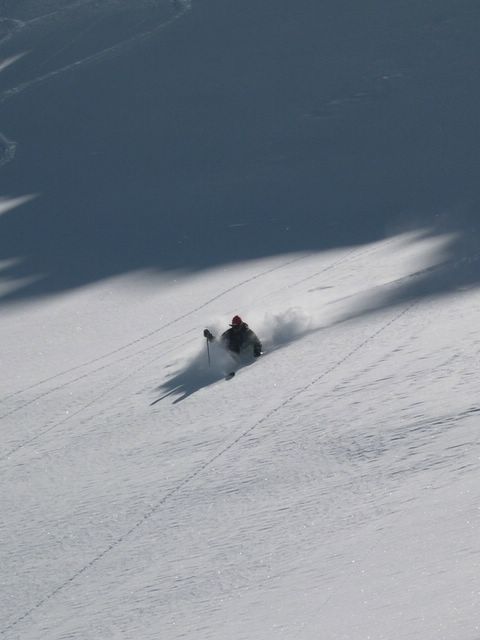
My friend John Nelson just got a job checking wolverine traps in the Sierras. It might not sound like an exciting job at first. But he is basically getting paid to go out on backcountry ski tours with a buddy of his to check these traps. He is living the dream while the rest of us are sitting in our offices bitching about how we are stuck skiing at Snow Summit! Granted, winter camping isn't exactly luxury. But he is living the dream. Seeing as though he was out this past weekend, I asked him to give us an update on what he's been up to. He sent me this entry. Apparently the Blackberry reception in Sequoia is better than I expected:
Dateline J.O. Pass, 9400'

Its cold as shit and has snowed 16". Three of us spent two nights out in order to check a bait station that was set up just northwest of Mt. Silliman. It took one day to walk in and find a place to camp. We spent the second day checking the trap, which is a motion sensitive camera pointed at a big chunk of venison. Everything is about eight feet off of the snow. The bait is on a pole that is wrapped in barbed wire in order to grab hair off anything that climbs the pole. We spent a total of about 20 minutes at the trap, which was actually a long time because it was too cold to stand around.

We got some pics of a marten, a jay, and a squirrel and no hair samples. The experiment was a success though because the camera worked when we tripped the infrared beam, which is a good indicator that the other 18 stations are also still working.

We ended up getting two phenomenal runs in over the course of three days, Alta gold for sure, but had to skin back out to Lodgepole because the snow was so deep and the walk long and flat. I have a few trips left to do and am headed to Onion Valley on March 1st to do some east side trips.

Tuesday, January 31, 2006

Backcountry Ski Trip Report: Red Mountain and Panther Peak

Last weekend (1/28-29), I again made the trek up to Central California to do some backcountry skiing. I'll be honest, the skiing wasn't very good. In fact it was pretty bad. But like all difficult things, it was a formative experience and I learned a lot. The story is best told by breaking it down into lessons learned.

Lesson #1: Avoid Parking in Grandma's Front Yard: On Saturday, we were planning on skiing Red Mountain, which is located between Shaver Lake and Sierra Summit on Rt. 168. So we drove up most of the way the night before and decided to sleep in the back of John's Explorer. We parked on the side of the road around midnight and figured everything was fine. I guess we were a little close to Grandma's house because her dog got wind of us around 1:45. Grandma decided to come out and find out if we were ok. She was actually pretty cool. She had no problem with us sleeping there for the night. It just took away from the little sleep we were getting in the comfy confines of the Explorer.

Lesson #2: Bring Toilet Paper: I've gotten too used to staying in places that provide you with toilet paper and of course forgot to bring my own. So shortly after waking up, I had to go and do my business...toilet paper or no toilet paper. Unfortunately, there were no leaves on the ground and all the trees were evergreens. I decided that they wouldn't be too comfortable or effective. The best solution I came up with was to grass wrapped with an old REI receipt.

Lesson #3: Get a Hide a Key: We arrived at the Red Mountain trail snow park around 7:15. We then had breakfast and put our gear on. To keep us entertained, we had the Sirius satellite radio blasting tunes from the "Hair Nation" station. A minute later, John shut his door and realized that he had locked the keys in the car (they were still in the ignition) with the radio still on. So we were presented with a dilemma. Do we go on the ski tour or do we get the door opened? Rather than getting a professional, we decided to try and open it ourselves. Picture John standing on top on the roof of the Explorer using one of his skis as a lever to pry open the door with me trying to jam my ski pole into the opening John created in a sad attempt at hitting the automatic lock button. As expected, it was completely ineffective. I was really surprised that no one driving by stopped as it looked like we were trying to break into the car. Once we gave up on doing it ourselves, we decided to go on the tour and deal with it later.

Lesson #4: Usefulness of GPS and an Altimeter: Neither John nor I had ever been out to Red Mountain. John had heard about it from a friend and had read a description of it on the Sierra Club Ski Mountaineer's website. But that was about all the knowledge we had. On the positive side, we did pick up a topographic map of the area. But unfortunately, none of the trails were labeled on the topographic map, the trails themselves weren't labeled very well, we were stupid and talked ourselves into taking the wrong trail. Not wanting to waste time, we decided to take what we thought was the geographic straight line to the trail we wanted to be on. We eventually made it onto the trail. But we were really never sure where we were on the map or how far we had left to go. We only realized that we were on the right trail when we reached West Lake at the base of Red Mountain. For me, the hike wasn’t the hard part. It was only 6.5 miles and the climb was very gradual. Most all of it consisted of following Snowmobile tracks. The hard part for me was the uncertainty. GPS would have obviously cleared that up. But as long as you have a topographic map, an Altimeter would also have given you a good idea of where of you were by telling you which iso line on the map you were on. (Note: This is similar to the technique we used on the sub where we would use ocean depth to fix our position.) If you want to do this tour without getting lost, just follow the signs at first for the Red Mountain trailhead and then for Red Mountain. (We errored in thinking that we were already on the Red Mountain trail as soon as we left the parking lot and that the first sign for the Red Mountain trailhead would loop us back to the parking lot)

Lesson #5: Bring Basic First Aid: About halfway into the hike, I got a pretty good sized blister on the back of my left ankle. When it first started hurting, it made me wish that I would have brought some mole skin with me. Luckily, John had a role of duct tape, which turned out to be an excellent temporary fix. We made a small duct tape square by putting folding one strip of duct tape in half (sticky side to sticky side). We put this against the blister and then taped that to my foot. So now you know one more use of duct tape. Despite the fact that this wasn't very serious, it did make me think about what I would do if something more serious happened. In the future, I'll definitely bring a basic first aid kit along with me and I might take a wilderness first aid course.

Lesson #6: The Skiing at Red Mountain is not worth the hike: Even if you don’t get lost, it’s a 5 mile hike to get to the top of the mountain. So it’s not easy to get to. The west facing ridge has a nice steep 400 ft vertical ridge. But it’s west facing. The north facing bowl we heard so much had a nice rocky steep section that last for about 30 vertical feet. It was followed by several hundred vertical feet of boring low grade crap. The snow at the top was very wind packed and slick while we did find some powder in the woods below.

The trip back to the car was easy. It took us 1.5 hours. Its not all downhill. So you’ll either have to put your skins back on or carry them like we chose to do. Thanks to the grumpy front desk guy at the Tamarack Lodge (just up 168 from the snow park), we were able to get AAA to send someone out to open the Explorer up for us. Amazingly, the battery was still full of juice with the radio going at full blast all day.

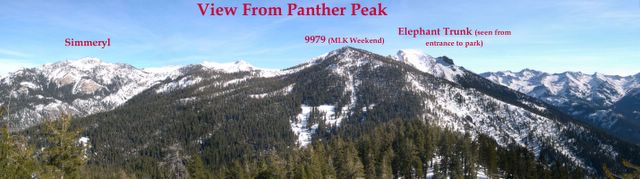
The next day, we skied Panther Peak at Sequoia National Park. The tour leaves from the Wolverton parking lot (just like 9979 which we did over MLK weekend). You just follow the yellow trail markers and it will guide you there. It only took us about 2 hours to reach the summit. The skin up was made easier by following John’s skin track from when he went up the previous weekend. The run down Panther Peak gives you about 700 vertical feet of low grade, north facing trees. The first 100 feet at the top is more exposed and we found it to have a very heavy crust. While not great snow down below, we had about 8” of heavy, creamy powder. You definitely had to have some speed to help you turn in it. But it was fun! By the time we went up for a second lap, it had warmed up substantially. This caused the snow to stick to our skins. In the future, I’ll be sure spray some of the Black Diamond Free Glide spray onto it the night before. Since we didn’t spray it on the night before, we used some Globstopper wax. While not totally fixing the problem, it at least allowed us to make it back up for a second run.

Wednesday, January 18, 2006

Backcountry Ski Trip Report: Weekend at Sequoia


I spent last weekend skiing the backcountry at Sequoia National Park. It was both the first time on my new AT gear and my first time backcountry skiing since 1995. It turned out to be a great weekend. We got close to 2 ft of fresh, dry powder between Saturday morning and Sunday afternoon. The biggest surprise to me was how dry it was. Although not quite Alta dry, it was pretty close. It dedfinitely wasn't the typical Sierra cement I've heard so much about. The snow line was only at 3,500 ft.

Each day, we drove up to the Wolverton parking area in the morning and went out from there. On Saturday, I was a bit apprehensive about going out in the middle of the storm. But for the most part, we stayed in the trees and my buddy John (who lives in 3 Rivers just outside the park) was very familiar with the terrain and assured us it was safe. We started off on the Pear Lake trail before breaking off to go to the top of the peak we call 9979. The initial hike to the bottom of the bowl took about 3 hours. I was pleased with my stamina. I had no problems keeping up with John and apart from my lungs, I didn't feel all that tired. After another hour, we made it to the top of the bowl. It's a nice north facing bowl. Visibility in the bowl wasn't great. But we could see. Although the terrain was great (low grade bowl leading to widely spaced trees for about 900' vertical), I skiied terribly. The AT boots were a lot softer than my downhill boots. Consequently, I had trouble keeping myself centered. I was either too far forward or I was leaning back. At least on the first run, it seemed that I couldn't link more than 5 turns without falling. I fell more on our two runs that day than I had all season long combined. By the second run, I knew what to expect from the boots and started getting the hang of the new boots. I could now link 8 turns before falling.
On day two, we got off to a late start. It was decided that we had to ski with the girls that day. We didn't actually go on a full fledged tour. Instead, we again went to the Wolverton parking area and did laps up the hill directly across from the sledding hill. It was affectionately known as the "Beginner's Slope." But apart from the very top, it had a good intermediate/expert pitch. There were even a few rocks to jump. The big advantage to the "Beginner's Slope" is that its only a 10 minute hike from the parking lot. The disadvantage is that the run is only 400 ft of vertical. So it takes quite a few laps to get good vertical. We were the only ones who thought it was worth skiing. So it was completely untracked. The snow was excellent (8-10" of good dry powder). In fact, it was probably the best snow we had all weekend.

On day three, we went back to 9979. Thankfully, we were greeted with a bluebird instead of a snowstorm. When we got to the base of 9979 bowl, we headed up the trees to the right (when facing uphill) instead of skinning directly up the bowl. We made good time and broke John's record with a time of 2:59 from the Wolverton parking lot. For our first run, we headed down through the trees we had just skinned up through. That face is northwest facing so the snow at the top was already pretty crusty. But once we got further into the trees (thinner and more exposed to sunlight at the very top) it was very good. We got some excellent video. Tyler and Carl quit after the first run. Tyler was tired and Carl's boots hurt. Dave, John and I went up for another 2 runs. We did one more run in the trees and finished it off with a run in the bowl.
All together, we climbed close to 10,000 ft of vertical throughout the weekend. For that, we got in only 9 runs. It might seem like a lot of work for not a whole lot of skiing. But it was absolutely wonderful. I actually enjoy the skin up. I like the fact that it forces me to slow down and enjoy the scenery. The other big thing is that you're guaranteed first tracks. Consequently, you have none of the anxiety that you have at a lift serviced ski area on a powder day. There is no mad rush to get to the powder before its tracked up. So you just end up taking your time and enjoy the day more. I know that I was spoiled with the snow quality that we had. But we were the only ones out there and it was great.