Showing posts with label Avalanche Safety. Show all posts

Friday, January 19, 2007

Backcountry Decisionmaking, the War in Iraq, and the Importance of a Questioning Attitude

With the almost complete lack of snow in Southern California, I spent last weekend getting caught up on reading rather than going on a previously planned ski trip to Sequoia National Park. I finished reading "State of Denial" by Bob Woodward and reviewing the Avalanche Safety Reader given out at the Avy Level 1 course I took last March. At first, I thought that they had nothing in common. It wasn't until Sunday afternoon when I was reading an article in the Economist, "Economics Focus: What the World Bank Knows", which was an assessment of the quality of research put out by the bank, that I realized what the link was. The point in the article that really struck me was that the Bank's leadership was consistently using untested research as gospel that their policies worked. They were looking for their in-house research to justify what they already wanted to do (prove that their aid programs and recommended reform programs actually worked) without criticizing the quality of the data or looking to see if it could also be used to show that their policies didn't work. This problem of trying to support the desired outcome is a problem that affects decisions everywhere from the backcountry to the White House to our everyday lives. I can guarantee you that none of us are immune to this.

In addition to putting out lots of information about how the environment (weather and terrain) affects avalanche safety, one of the big points that S. P. Parker, our instructor at the avy clinic, put out was the need to be aware of what is going on in our minds while making the decision about whether or not an area is safe. He brought up the fact that there's a catch-22 that exists in that the terrain we most want to ski often has the highest avalanche danger. The steep powder field that looks so nice also has a 35 degree pitch and has been having wind deposit snow on it for the last 10 hours. These are all major danger factors. But S.P. pointed out that all too often very experienced people ignore these danger factors and look for reasons why they should ski the terrain. Even if they do recognize that the danger factors do exist, they neglect to give them the proper consideration. Some of the messages that go on inside the brain of our friend Homo Powdericus are:
1) I've just spent 3 hours skinning up this mountain. There's no way I'm leaving without good turns.
2) It's been 1 month since I've gotten half decent powder. I don't care what signs I'm seeing. I need freshies.
3) It looks soooooo gooooood!!! I've never gotten hurt before. So I'll be fine this time.
4) Everyone seems to think its safe...so it must be.

These are all rationalizations that have gone through my head at some point to justify skiing a potentially dangerous slope to get some good turns. In retrospect, I recognize that they weren't very smart. They encouraged me to ignore my gut and not fully consider the downside to the decision.

A related issue that S.P. brought up is the tendency for groups to delegate decision making to those with the most experience. What this means is that a group of people will often just follow the most experienced person. He brought up numerous case studies where many of the lesser experienced people did notice danger factors and were concerned about them. But they neglected to speak up because they had decided to follow the person with the most experience. They figured that he noticed the danger factor and had given it the proper attention.

For those of you who haven't read it, I highly recommend reading "State of Denial". It's Bob Woodward's narrative and analysis of the decision making process behind going to war in Iraq and our subsequent strategy for fighting the insurgency. It was largely based on interviews Woodward conducted with key policy makers within the Bush administration. Whatever your politics are, the book is interesting in its lessons for decision making. Woodward argues that like our friend, homo powdericus, key members of the Bush administration did not maintain a questioning attitude. They both failed to question the validity of the evidence justifying their action (WMD intelligence that was 5-10 years old). Additionally, he argues that they failed to adequately consider the downside (not finding WMD, Iraqi infrastructure being in poor condition, the population becoming hostile and the possibility of Shia vs. Sunni fighting) of their decision. Within the government, there were numerous high ranking officials/military officers who did have serious doubts on all of these issues and failed to speak up just like the backcountry skiers who delegated decision making authority to the person with the most experience.

I do not intend this to be open up a discussion about the merits of the war in Iraq. THIS BLOG IS NOT MEANT TO BE POLITICAL! What I do want to show is that these decision making errors do take place and can result in serious consequences.

Within the submarine force, one of the guiding philosophies is to maintain a questioning attitude. What this means is to always question the information being presented to you (where did it come from, does it make sense when seen against current indications/past history, could it be wrong, etc), to use conservative assumptions (not politically conservative, but try to avoid “la la” land assumptions) and to always look at both the pros and cons. A key part of this philosophy is that it’s every crew members’ responsibility to speak up if they have a concern. What this means is that we expect the most junior sailor to speak up if they have a concern. While I at times found this frustrating while I was serving on board a submarine (USS Toledo), it helped to keep us safe while we were operating hundreds of feet underwater. Just like on the submarine, a questioning attitude will help to improve our decision making and to keep us safe, whether it’s at work or at the top of a mountain in the backcountry. I'm not saying it’s easy to maintain. But at the very least we should be aware of it.

Tuesday, March 21, 2006

Avalanche Safety Course

At the very beginning of this ski season, one of the promises I made to myself was to take an avalanche safety course. Previously, I had done a little backcountry skiing (twice in high school) and had skied quite a bit of powder, but I didn’t have a clue when it came to whether the slope I was on would actually slide. Looking back at some of the things I had done in the past, I knew that I was lucky not to have gotten hurt before.

Back in college, I did the standard semester abroad my junior year. I lucked out and ended up studying in Grenoble, France during the winter of 1999. That turned out to be one of the biggest snow years Europe had in recent years. Consequently, every weekend turned out to be a powder weekend. If you don’t know, there is no such thing as avalanche control in Europe. You go off-piste at your own risk. That winter, we used what we called the “Three-Track” Rule. It stated that if there were three or more tracks going off piste, it could be assumed that any avalanche that could take place, would have already taken place and it must therefore be safe. Not very smart, I know. But we were just reckless college students then.

Even though taking the avalanche safety course was one of my top priorities at the beginning of the season, I kept on putting off taking the course. I never had a sense of urgency. After all, one of the people who I normally skied with was very experienced in the backcountry. I trusted that he knew when it was safe to be out and when it wasn’t. I conveniently ignored the fact that no one else in our group had any significant experience. Furthermore, I bought into the argument that the western Sierra snow pack was more stable and not as prone to avalanches.

Eventually, I decided that these excuses just didn’t hold up to closer scrutiny and demanded that I learn more about avalanche safety. No group should rely solely on one person’s judgment. Each member should have sufficient knowledge to form their own opinions and to contribute to group decisions. If you’re just depending on one person, who is going to back them up when they make a mistake? What would happen if they got hurt? Besides the group responsibility issues, the western Sierra snow pack argument didn’t really hold up either. Two weekends ago we were skiing on 2.5 feet of super dry snow that was more like what you’d find in Utah than the Western Sierras. Despite the fact that we didn’t set off any avalanches, the snow that weekend was definitely susceptible to sliding. Again, nothing happened to us. But sooner or later everyone’s luck runs out. So I finally decided that it was time to give up a weekend of skiing, take an avalanche safety course, and take personal responsibility for my own safety while out in the backcountry. I no longer wanted to rely solely on luck and my friend’s judgment.

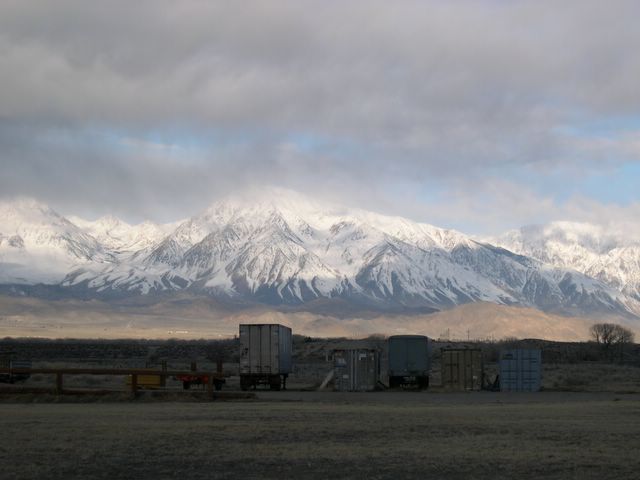
So I spent last weekend (Saturday through Monday) taking the Sierra Mountain Center Avalanche Level One course that was being given in Bishop, CA. The course was taught by S.P. Parker. He opened the course off by telling us that the course was not going to give us the one answer. In other words, nothing we were going to learn was going to tell us that a slope was 100% safe. There are simply too many factors that influence whether or not a slope will slide. Instead, the course was designed to teach you the right questions to ask yourself so that you could make an informed decision and minimize the risk of your or your party getting caught in an avalanche.

On the first day, we spent the morning in the classroom discussing case studies, types of avalanches, rescue procedures, how terrain influences the potential for avalanches, and routefinding. The afternoon was spent in the field looking at the actual terrain for signs of avalanche danger and practicing using our beacons. I found this really useful since I had never had much success practicing with my beacon before. (I’ve got an Ortovox M2. While its range is better than the digital beacons, it definitely takes more practice to use it effectively.)

On day two, we again spent the morning in the classroom covering additional case studies, group dynamics (what leads groups to make poor decisions), influence of weather, and snow pack theory. In the afternoon, we drove to Table Mountain and dug snow pits. S.P. showed us how to identify the different layers and to perform tests to determine how well the different layers had bonded to each other. I was surprised when S.P. said that he didn’t dig snow pits very often. He only considers them to be one of many factors that help you to determine what level of avalanche danger exists. He emphasized that other factors such as slope angle, wind loading, weather, sun exposure, terrain triggers, how the snow feels (slabby, soft, crusty, etc) and signs of recent avalanche activity should all help you to form a good picture of the degree of avalanche danger present. You only need to dig a pit when you are still unsure after looking at all these other factors.

Day three was spent in the field near Mammoth Rock. We spent the morning examining the terrain for signs of avalanche danger (recent slide activity, wind loading, slope angle, etc), discussing safe routes, and digging another snow pit. In the afternoon, we got in a short run (8” of excellent fluff with wind-pack in places) before practicing multiple burial (2 –3 people) searches. I found the multiple burial scenario much more challenging. Personally, I had a difficult time with my analog beacon (M-2) picking out where each victim was. I realize that I still need to a lot more practice with this scenario. We also learned that team organization plays a big role in coordinating search efforts to make sure that everyone isn’t converging on the same victim.

So was the course worth the $350? Definitely! You can’t put a price on your life. But like S.P. said in the beginning, it’s not the answer. If you are looking for the definitive safety guarantee, you are better off giving up backcountry skiing and staying at a resort. As an avalanche safety instructor should, S.P. comes off as being very risk averse and prudent. In the course, he would never say that a pitch is completely safe to ski down or skin up. It always felt like the textbook answer was to either go up or down the windblown section with no snow on it. But that is precisely because avalanche safety is not an exact science. It's about minimizing risk intead of eliminating it as well as knowing how much risk you are incuring and being comfortable with that. I do feel that the course gave me the tools to better judge how much risk I am taking on each run. Right now, I know the questions to ask and which factors are most important. The next step is to gain more experience so that I can better weight all of these factors to form a more accurate picture.